FREE Water Filter


Well it's not really free, but close to it, and you have to build it.
But it is so easy, cheap, and effective, you can't do better
without spending a fair little bit of money.
And your per gallon cost of good clean freshwater is a
fraction of other methods. It can be built in an hour for
less than $20 and produce absolutely aquarium grade
acceptable freshwater for pennies a gallon.

First I'll rant about water filters in general for a moment.
Many people use De-Ionized (DI) or Reverse Osmosis (RO)
water for their salt mixing base freshwater.
For many people this is the only way to get good clean
water free of silicates, phosphates, and other things
you don't want to start with and that shouldn't be
in our dang drinking water in the first place!
Things you'll be buying stuff to remove later.

Both of these types of filtration are expensive to buy
and to operate (per gallon costs). DI is medical grade
sterile water. Not much like the ocean, would be my guess.
In essence, you add everything to it to "re-constitute"
or fix it back up after the process for use.
RO likewise is very sanitized mineral and element free.
Being a low-tech guy they seem "too clean" in some ways
for my tastes, compared to nature. Yes it gets all
your metals out, and then some, but is it the neccessary minimum?

I have kept freshwater and saltwater fish for decades,
on the east coast, the west coast and in the central U.S.,
with neither of the above systems, so therefore would
say they are not absolutely required for success everywhere.
If you live in an area with really bad water, they might
be the only way though. They have their place, where
the water is bad for fish. Then you probably shouldn't
be drinking it either !!

For many people their water is simply not THAT bad to
begin with that it must be surgically molecularly altered
to clean it up. For them, there is an easy, cheap, and
very effective way to make your own clean base freshwater
for mixing without spending a fortune, and that is what
we want to share with you.

Here is a simple design idea for a water filter that will
give you "glacier melt" grade pure water.


BUILDING THE FILTER  -  Parts and Materials


Filter Housing Materials needed:

Pipe
1 pc. ~ 2' length of 1.5" PVC schedule 40 pipe
   * Note: obviously you could use 20" or 18" too,
    but I wouldn't go any shorter than that.

2 pcs. ~ 3" length of 3/4" PVC schedule 40 pipe
Fittings (all slip)
2 pcs. ~ 1.5" PVC Elbows
2 pcs. ~ 1.5" to 3/4" adapters
1 pc. ~ 3/4" to hose fitting adapter

Wash all the fittings being sure to remove
any price stickers and their glue, especially if
they are where the fittings seal (sides).
A dry thumb will often work well for that.

You often have to buy PVC in 10' lengths, but ask your
fish store, grandpa, or plumbing shop for two 3" pieces
of 3/4" pipe and a 2' piece of 1.5" if you don't want the
extra pipe.  If your plumber or plumbing shop will
give you some, buy the fittings from them.


External Materials Required:

One Water Hose ~ Do not use the green garden variety hose
to make good clean water with.   Many of these are made with
recycled materials of who knows what.   Most are
marked "not for drinking water." What you need is a
good "drinking water" hose. They are usually white, and
you can find them in the camper/camping or marine/boat
department. The filter will not positively take out
whatever might leach from cheap non-drinking water hoses.


Tools You Might Need:

1) Hacksaw or small power jigsaw for cutting the
    PVC to length, if neccessary.
1a) which do so now if need be
2) Mallet (rubber) to pound pieces together well

Big strong men might be able to just press
it together sufficiently to hold it; otherwise
use the mallet.   Remember you'll have
to take it apart when changing the carbon!   :):)
And it will build a little pressure when in operation.

This unit will not be glued together, only pressed
(pressure) together so the PVC glue won't be used.

___________________________________________


Filter media needed:

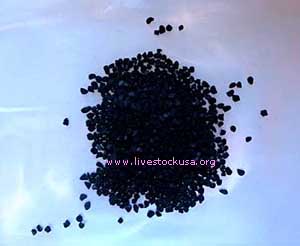
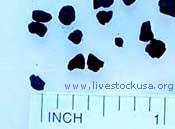
1) The highest grade,
best carbon you can afford

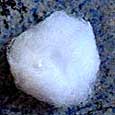
Spun Cotton/Wool Stuff
2) Filter wool/floss
spun cotton stuff

3) Chemi-pure type polymer pad
for chemical removal
High-quality Carbon

High-quality Carbon
___________________________________________

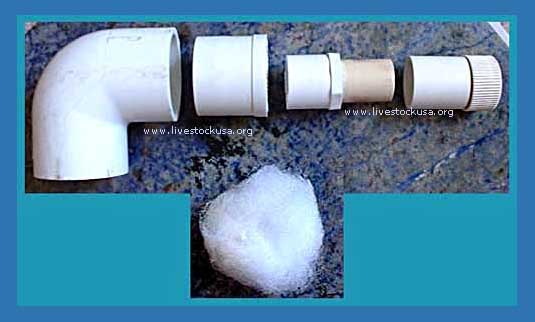
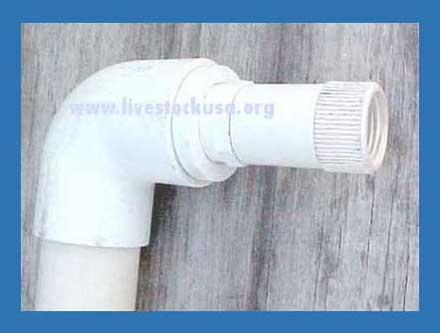
Water Filter Parts
From left: the elbow (which gets packed solid with wool);
then the step-down adapters (two in this case);
then the 3-inch long 3/4" pipe stub that finally
the hose adapter fitting goes on.
NOTE: If they don't have a 1.5" to 3/4" adapter, you may
have to use a 1.5" to 1", then a 1" to 3/4" as shown here.

___________________________________________
BUILDING THE FILTER - Assembly

Assuming you have all the parts together in front of you:
Let's assemble the beast, shall we?

Take one elbow (let's start with the top elbow) and stuff it
pretty hard packed with the wool/cotton/polyester synthetic
fiber whatever stuff.  This is the mechanical filtration.
This elbow will be at the inlet and get very dirty, very
regularly and will need regular changing of the wool at
this "entry port" (top) side. You will likely be surprised
what the first layer catches!  Do not look at it under
a microscope or you will never drink city water again. :):)

In the other elbow - the exit or bottom side, stuff it
hard only half way or a bit more.   Cut a circular piece
of the Chemi-pure (polymer) pad and insert it into the elbow,
and finish by packing wool outside of it.   Now, remember
which one has the pad because you only want it being
used after everything else has been cleaned out
of the water - the last stage or step of filtration.

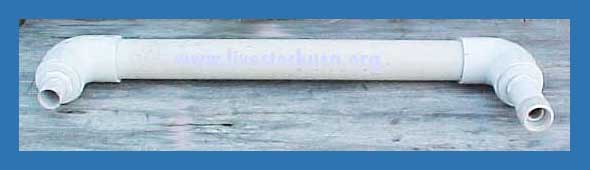
Water Filter
Take the bottom elbow (with poly pad) and insert the 2' long
piece of 1.5" pipe into that bottom elbow with the poly filter pad.
Always twist PVC as you put it together, glue or not.
Take the rubber mallet and pound on top of the
2' long piece to seat it all the way into the elbow.

Now fill the tube with carbon. Stop a couple of inches from
the top and put a wool plug above carbon. Once I didn't
have the wool in the bottom elbow tight enough and the
carbon weight pushed it out as I poured, and carbon went
all over the floor (quit laughing), so now, I cover the
bottom opening of the elbow with my hand now,
just in case, while I pour the carbon into the 2' pipe.
It takes a pound or two of carbon to fill the pipe I think.
Never measured and always using big bulk bags,
so don't know.

Then put the top elbow (stuffed with wool) on the 2' pipe,
and use the mallet to make sure it is well seated on the 2'-long
(now carbon-filled) pipe. Now you have two elbows on the pipe -
be sure to remember which one is top and bottom. I like to have
them aligned the same way, and always make the lettering on the
2' pipe read downward so I know what end is up :) !

Next insert the two 1.5" to 3/4" adapters into the open ends
of both elbows.   Use the mallet and pound them in.
Now you have a very standard 3/4" format to work with.
Insert the two 3/4" pipe pieces (the 3" long pieces)
into the 3/4" hole. Pound them in with the mallet too.
Don't beat them to death, just gently tap them down
to seat them firmly. You'll feel when they are fully seated.
Hopefully you can find the 1.5" to 3/4" and not have to use
2 stepdown adapters (1.5 to 1" and 1 to 3/4") as shown here.
Water Filter
This filter has 2 stepdown adapters as
explained earlier, not a 1.5 to 3/4" as
explained in the instructions.
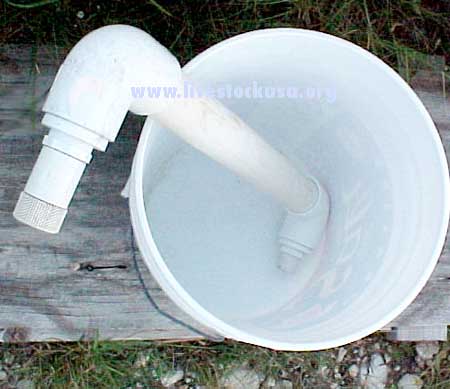
On the top end put the hose adapter fitting on the 3/4" stub.

Put the unit in a 5-gallon bucket, screw the drinking water hose
to the fitting which will seat and seal when you tighten it up.

Water Filter and Bucket


You are ready to make water.

The key to the effectiveness of this filter is flow rate
during filtration.   Only one rate works: SLOW !!
If you have good water pressure you might blow the thing
apart if you turn it on high anyway. The water should be
dripping at a nearly countable rate or just barely faster.
It should be a trickle.  A seep.   Like a dripping faucet.
The water flow should be as low as you can get it to move.

When you first turn it on it will take a while for water to
fill up the tube, carbon, and wool, and even start coming out.
Patience my friends. It is critical you adjust it to the
slowest possible flow.   Remember a drip a second is many
gallons in a day.  Don't leave it on in the house and leave!
Out in the garden, fine.   I have used both methods.
Only one will get you sleeping in the house on a bed.

The magic is in the slow flow, which builds up pressure
within the tube, forcing all the water through all the
carbon, which is one of the best chemical filtering agents
known.   It takes out just about everything.   Of course
the water was *supposed* to be clean when it was delivered,
but as you will see in cleaning the topside entry port wool
regularly, there's a mess a stuff in it!   Note 20% of America's
drinking water supply does not meet federal standards
in one way or another!!!  Of course, after the prefilter,
the carbon and post filter, the chemi-pure poly pad
removes any remainder of what we might consider noxious
chemicals that might have gotten by the carbon that
we don't want to start a "new aquarium water mix" with.


VOILA !!

Snow melt !

For pennies a gallon !
Crystal-clear Filtered Water


I use a couple of 5-gallon (or larger if you use a lot) buckets
for storing already to go clean freshwater.
Best are the ones that really seal well when storing.

Remember to regularly check the inbound entry port
cotton/wool and keep it clean. How long the carbon
lasts will vary with the grade of carbon you are using
and the volume of water you are cleaning. Using a very
high grade of carbon, at least a thousand gallons
can be filtered without thinking about checking the carbon.
Check the poly pad when changing carbon.

To change the wool filters, pull the whole elbow assembly
(elbow to hose adapter or elbow to stub) off the 2'-long
carbon-filled pipe as one piece rather than disassembling
each part. Remove and replace wool.
It is easy to change the carbon when you have one of
the elbows off. Just pour it out and replace with new.
The bottom exit port will not appear to need much
changing but you might as well change the wool when
you do the top entry port. Bacteria might be on it.
The poly filter is good until it visually turns color.

If you know your water has a certain something evil in it,
you can probably get a polymer pad that will remove it,
and add that to the final step stage. Be creative.
Find out what you do have that you don't want in your water.
There is something to remove it that can easily be
inserted to this filter - but always at the bottom
as a final stage.

Happy H2O !

birdfish


Home

Our E-mail


To Our Site Map
To Our Site Map


To some of our other articles ...
Acclimating Your Fish at Home What is Boat Rock? CITES Permits
Temperatures Free Shipping? Clarions and Leopards
Salinity Photo Pirates Marine Mammals
Hyper-salinity $15 a Box
Free Invert Food Live Rock, Corals, Reefs
and Conservation
How to Spot a Spoof


To view other pages, you may
choose from topics in dropdown menu ...


Curing Live Rock


Acclimating Your Fish at Home


© www.livestockusa.org, 2006-2007


Script provided by JavaScript Kit